

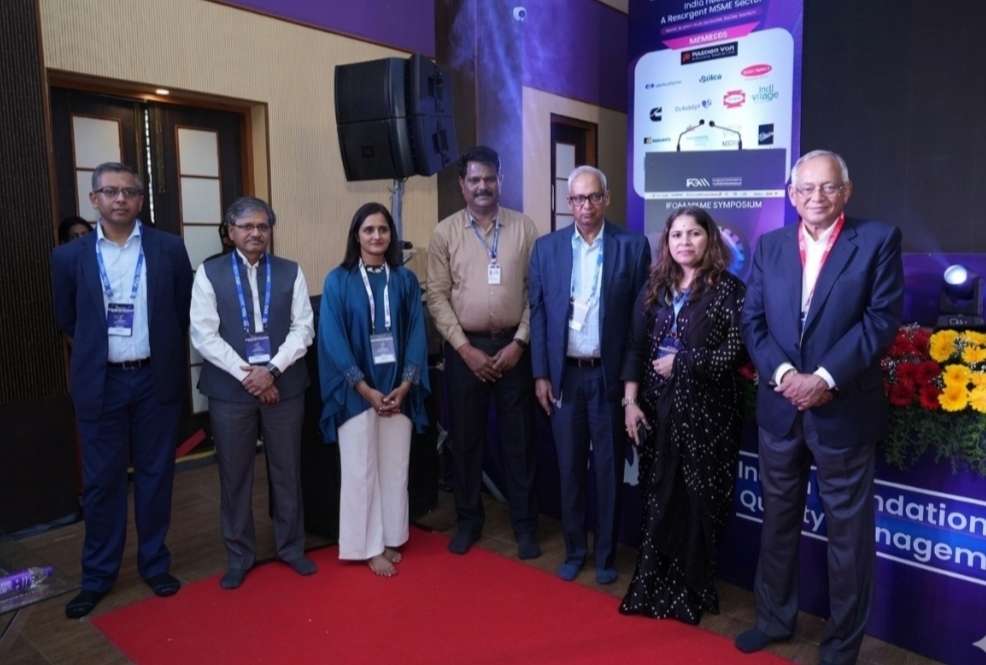
IFQM’s FIRST MSME SYMPOSIUM CALLS FOR A “NATIONAL QUALITY SPRINT” TO INTEGRATE WITH GLOBAL VALUE CHAINS
250+ MSME CEOs, industry captains, and academia convene in Chennai
Leaders from TVS, Boeing, Motherson, Maruti Suzuki, Cummins, L&T, Bosch, ZF, and Deloitte engage MSMEs on quality, global value chain integration, and digital transformation
IFQM launches Quality Excellence Prize for MSMEs, Leadership Development Course, and two industry-designed university courses
Chennai, March 20, 2026: The Indian Foundation for Quality Management (IFQM) convened its first MSME Symposium at Anna University, Chennai, bringing together over 250 MSME CEOs, CPOs and CEOs of large companies, quality experts, and academic leaders to deliberate on making India’s Micro, Small, and Medium Enterprises (MSMEs) globally competitive and export-capable. The symposium, themed – India Needs… A Resurgent MSME Sector – called for a “national quality sprint” to integrate with the global value chains.
Delivering the keynote address, Venu Srinivasan, Chairman, IFQM, said, “If MSMEs grow in their journey, not just to better productivity, quality and profitability but to become large companies for strategy, technology, products, innovation and growth, it will be a breakthrough in creating a new India. The MSME transformation agenda can have some very simple objectives – do cell formation, double your productivity, reduce your quality defect by half, reduce your inventory by half, reduce your space by one-third, all this in about 12 months and we will be well on our way. IFQM is taking this force multiplication effort by taking a cluster approach – ten MSME clusters covering 67 MSMEs is already in place – and this I believe is not just an effort to improve the MSME ecosystem but our long term aspiration to build brand India.”
The MSME symposium featured four panel discussions, two case studies, and four concrete launches aimed at bridging the quality gap between India’s MSME ecosystem and global manufacturing standards.
Soumitra Bhattacharya, CEO & Director, IFQM, said, “India is amongst the fastest growing large economies, but our share of global trade is still under 2%. The bridge between GDP growth and global competitiveness is quality. Germany’s Mittelstand — our MSME equivalent — contributes 68% of that country’s exports. India’s 7.69 crore MSMEs have not reached anywhere close. The difference is not scale — it is quality systems, supply chain integration, and a culture of precision. Through this symposium and the programmes we have showcased today, IFQM is putting practical tools in the hands of MSME leaders — not policies on paper, but frameworks they can act on starting immediately.”
“India is in a sweet spot, and yet this opportunity has to be grabbed on merits. No one is going to give us a passthrough just because there is a big global geopolitical tension across the world and India could be a safe haven. We will earn our right by focusing on daily work management, continuous improvement, counselling and assessment and adherenece to global benchmarks,” he added.
India’s MSME sector accounts for 31% of GDP, 35% of manufacturing output, and nearly 49% of exports, employing 32.8 crore people across 7.69 crore registered enterprises. Yet India’s share of global merchandise exports remains at approximately 1.8%, and its IMD World Competitiveness Ranking slipped to 41st out of 69 economies in 2025. The symposium addressed this growth-competitiveness paradox head-on, with industry leaders sharing actionable frameworks, global benchmarks, and MSME transformation case studies.
Key Sessions and Industry Engagement
The symposium featured a cross-section of India’s industrial leadership engaging directly with MSMEs. The opening panel, “India as a Global Manufacturing Hub,” moderated by Ashwani Bhargava of Boeing India, featured panellists from Bosch (Madhav Dusane), Cummins India (Kavita Sandeep Kaushik), and LGB (Prabakaran), who examined what global OEMs look for when sourcing from Indian suppliers and the quality benchmarks MSMEs must meet to enter global value chains.
Pankaj Mital, Vice Chairman, Motherson Group, presented a case study on how Motherson transformed from a single Indian MSME into an $18-billion global company — offering a replicable roadmap for Indian manufacturers. A second panel on “Growth in the Domestic Market,” moderated by Arvind Balaji of Lucas TVS, included CV Raman of Maruti Suzuki, alongside leaders from TVS Motor, L&T, and TEPL, discussing how MSMEs can scale within India’s domestic supply chains.
A distinctive session titled “Listen & Unravel,” moderated by Deloitte, brought industry leaders face-to-face with MSME entrepreneurs to understand their on-ground challenges, while a “Solutions & Roadmap” panel moderated by Dr. Jairam Varadaraj offered concrete remedies and course corrections, including L&T SUFiN’s financing solutions for small manufacturers.