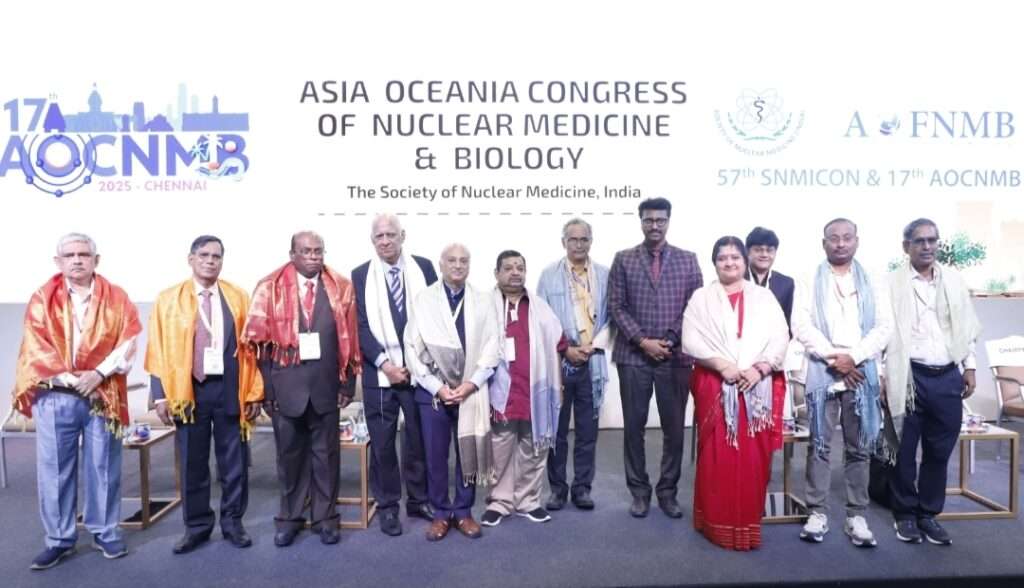

The third day of the 17th Asia Oceania Congress of Nuclear Medicine and Biology (AOCNMB 2025), underway in Chennai, continued to
showcase advanced scientific exchanges, with the sessions’ thematic focus being expanding the role of oncology in nuclear medicine research
and clinical practice. The day commenced with scientific presentations by young nuclear medicine physicians and researchers from across India
as they presented their recent findings. It reflected the growing depth and diversity of nuclear medicine research being conducted pan-India.
Each presentation was followed by structured scientific discussions, enabling senior experts to engage with the presenters, offer insights, and
assess the clinical relevance of their work. The oncology-focused scientific sessions highlighted the critical role of nuclear medicine in cancer
diagnosis, staging, therapy planning, and response assessment, reinforcing nuclear medicine’s position as a key component of multidisciplinary
cancer management.
A senior panellist expressed his appreciation for India’s current capabilities in managing civil nuclear disasters and emergency preparedness,
noting the country’s structured and evolving approach. There was also a workshop on Management of Civil Nuclear Disasters, by Indian Society
for Radiation Physics, anchored by Dr. Venkatraman. Formerly IGCAR, which covered “Defence in Depth”, of India’s nuclear program,
radiation risk sources, roles AERB, NDMA, DAE and state. Radiation monitoring, assessment and medical management, and lessons from
global incidents were also discussed. Lastly, the table-top demonstration was also enacted by the Kalpakkam Team.
Addressing the importance of lifelong learning among medical professionals involved in governance, this senior panellist highlighted the need
for structured educational refreshers for administrators with medical backgrounds. He stated, “The trend I see is that many IAS officers were
physicians before entering administrative services, which offers a distinct advantage. However, once they transition fully into administration,
their clinical knowledge can become somewhat rusty. I would suggest implementing national-level online courses—possibly integrated into the
general teaching curriculum—so that medical students and practicing physicians alike can benefit. Programs developed in conjunction with
institutions such as the IITs or similar academic platforms could help standardize and refresh medical knowledge across the country.” His
remarks sparked thoughtful discussion among delegates on interdisciplinary education, policy support, and the role of digital learning platforms
in strengthening healthcare leadership.
The day concluded with insightful talks by eminent faculty including Dr. E. Prabhu, Dr. Natesan Ramamurthy, and Dr. G. N. Mahapatra, among
others. During the People-to-People interaction session, both Dr. Ramamurthy and Dr. Prabhu remained highly engaged as audience participants,
reflecting the conference’s collaborative spirit. In a moment of humility, Dr. Prabhu referred to himself as a “common scientist,” a remark
warmly received by delegates. Dr. Ramamurthy, who also served as Chairperson for the morning research presentations, responded actively to
questions regarding the availability and accessibility of nuclear medicine resources, particularly for the common man seeking PET scans and
other advanced diagnostic services.
For official correspondence, registration details, programme schedule, media queries, and further information related to the conference may be
accessed through the official communication channels given below: