

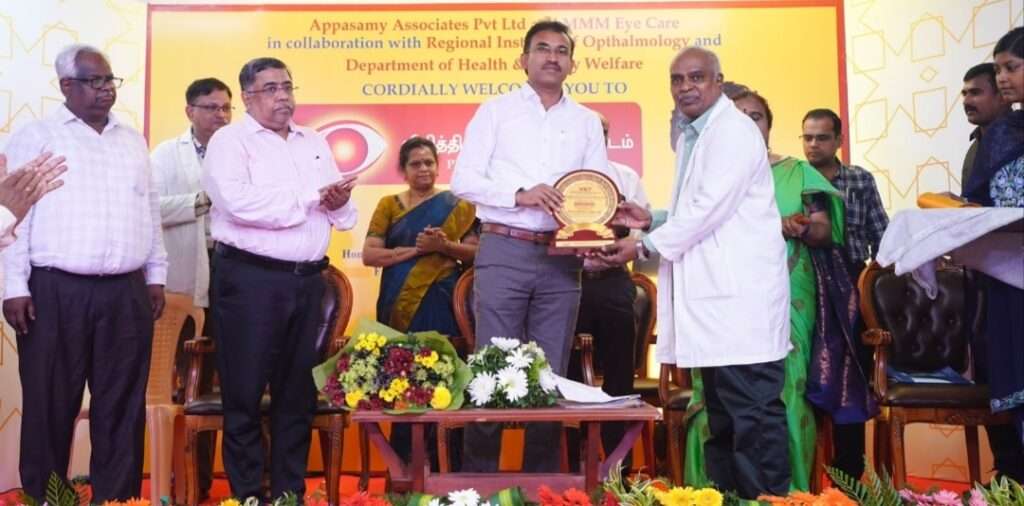
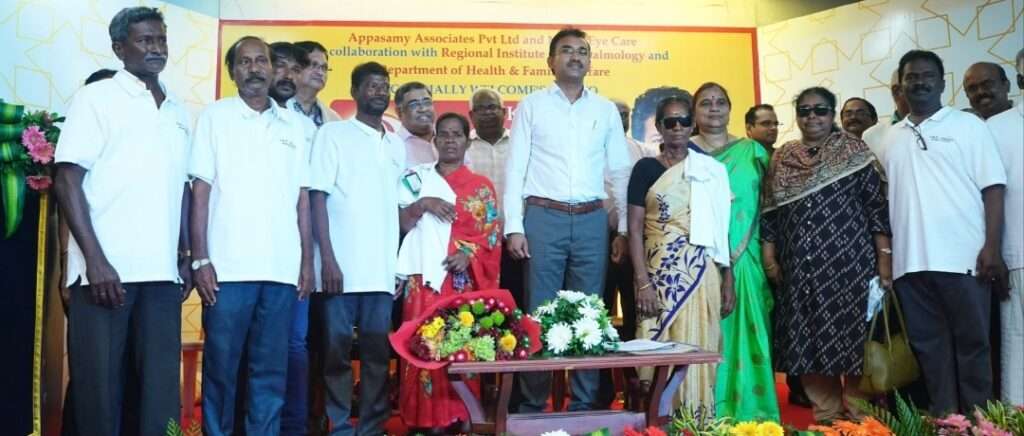
Chennai, As per the directions of the Hon’ble Chief Minister of Tamil Nadu, the pre-launch event of the “Vizhithirai Kaappom” (VKT) Scheme, under the Department of Health and Family Welfare, Government of Tamil Nadu, was held today at the Regional Institute of Ophthalmology (RIO), Government Eye Hospital, Egmore, Chennai. The event was organised by MMM Eye Hospitals, with Appasamy Associates as the sponsor, in coordination with the concerned government authorities and ophthalmology leadership.
The event was inaugurated in the presence of Dr. K.G. Arunraj, Hon’ble Minister for Health, Medical Education and Family Welfare, Government of Tamil Nadu.
The event was also attended by Dr. Darezh Ahamed, IAS, Principal Secretary, Health & Family Welfare; Dr. S. Subramani, IAS, Project Director, Tamil Nadu Health Systems Project (TNHSP); Dr. V. Lokanayaki, Director of Medical Education & Research; and Dr. K. Shantaram, Dean, Madras Medical College & Rajiv Gandhi Government General Hospital (RGGH), along with senior ophthalmologists, academic leaders and healthcare professionals.
During the event, the Hon’ble Minister highlighted the Government of Tamil Nadu’s initiatives towards strengthening healthcare infrastructure and improving access to timely and advanced medical care. The significance of early detection and treatment of retinal disorders, particularly those associated with diabetes and hypertension, was also emphasised.
Retinal damage is more likely to occur due to diabetes and hypertension. In India alone, approximately 101 million people are affected by diabetes, while another 136 million people are in the pre-diabetic stage. One out of every seven diabetic patients has retinal involvement. The prevalence of diabetes in rural areas is approximately 19.8% to 22.5%, while in urban areas it is approximately 32%.
Through the Vizhithirai Kaappom Scheme, there will be an opportunity to detect retinal damage at an early stage and provide appropriate treatment, thereby helping to prevent vision loss.
Dr. Vinayak Murthy, Director, Regional Institute of Ophthalmology, said:
“Retinal disorders associated with diabetes and hypertension can progress without obvious symptoms in the early stages. Strengthening screening and referral pathways will help identify retinal changes at an earlier stage and enable patients to receive timely specialist care. Vizhithirai Kaappom is an important step towards bringing structured retinal screening and treatment closer to the community.”
Retinal Screening from Primary Health Centres to Medical College Hospitals
The scheme is planned to be implemented from Primary Health Centres and Taluk Hospitals up to Medical College Hospitals.
Under the scheme, advanced technologies such as laser-based technology will be utilised for retinal screening of the general public. The scheme will also create awareness among the public regarding retinal damage caused by diabetes and will be expanded into a broader implementation framework.
At the Vision Centres in every district, the infrastructure required for retinal screening and detection will be upgraded.
At Taluk Hospitals and District Headquarters Hospitals (Reporting Centres), retinal examination reports will be reviewed/referred by ophthalmic specialists, and modern treatment methods will be undertaken as required.
Dr. Rajshekar, Chief, Retina Services, Regional Institute of Ophthalmology, said:
“The strength of Vizhithirai Kaappom lies in creating a clear pathway from screening and identification of retinal conditions to specialist evaluation and treatment. With strengthened facilities across different levels of healthcare and referral centres, the initiative can help ensure that patients who require advanced retinal care are identified and referred at the appropriate stage.”
Advanced Retinal Screening and Treatment
At Medical College Hospitals and District Headquarters Hospitals, retinal screening will be further strengthened through equipment such as OCT (Optical Coherence Tomography) and FFA (Fundus Fluorescein Angiography).
Treatment modalities including laser treatment and injections will be provided by Medical Retina Specialists.
Advanced Retinal Surgical Facilities at Nine Zonal Centres
Advanced retinal surgical facilities will be strengthened at the Zonal Centres located in Medical College Hospitals in nine locations across Tamil Nadu:
Chennai, Vellore, Villupuram, Tiruchirappalli, Salem, Coimbatore, Thanjavur, Madurai and Tirunelveli.
The required infrastructure will be developed at these centres, along with advanced training and postgraduate training for ophthalmologists and nurses, to further strengthen retinal-care services.
Government Eye Hospital, Egmore to Serve as Reference and Apex Training Centre
The Government Eye Hospital, Egmore, Chennai, will function as the Reference Centre for referrals requiring advanced treatment under the “Vizhithirai Kaappom” (VKT) Scheme.
The hospital will also serve as the Apex Training / Mentorship Centre for advanced treatment and training.
Dr. S. Bernard, Director & CEO, MMM Eye Hospitals, said:
“Vizhithirai Kaappom marks an important step towards strengthening early detection and timely management of retinal disorders. The initiative brings together screening, referral, specialist care and training in a structured manner. We are pleased to have supported and organised this important pre-launch programme and to contribute to an initiative focused on strengthening retinal care and preventing avoidable vision loss.”
The Government of Tamil Nadu is well prepared to implement the scheme effectively.
As this retinal-care initiative is being launched in Tamil Nadu for the first time in India, the scheme is of historical significance and is expected to serve as a pioneering initiative.
The scheme will contribute to India’s medical and healthcare infrastructure by enabling the early detection of retinal disorders among the general population and facilitating the provision of necessary treatment.